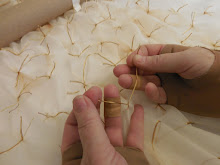
After the guild show this weekend, Rosalie Dace taught a class called Line Dance in which she demonstrated practical ways to create lines with specific qualities (e.g., v-e-r-y skinny lines, random curved lines) and also showed a lot of examples of lines in photographs and art. One of my favorite things from the class was her characterizations of line as:
Straight Horizontal Vertical Diagonal Continuous Broken Random Crunchy Thin Thick Soft Gentle Repeated Make a shape Suggest a shape Define an edge Overlapping Rhythmic Wavy Suggest tracery Lacy Fuzzy Parallel Dark Light Different scales Wide Narrow (NB: I'm not sure how -- or whether -- "thick/thin" differs from "wide/narrow" but there is the whisper of a distinction in my former wordmongering mind.) Organic Curved Shadows make lines Spaces between shapes make lines (like mortar lines between bricks) Grids Weaving Zigzag Over an image Radiating
So many intriguing possibilities beyond "stipple" in the machine's programmed stitches guide, isn't it?
Showing posts with label classes. Show all posts
Showing posts with label classes. Show all posts
Wednesday, May 4, 2011

Sunday, October 11, 2009
fun, fun, fun
Lots to catch up with. I'll start with the classes I took this weekend. (I'll finish with them too. It's getting late and I do have to go to work tomorrow.) Lynne Perella -- author of Alphabetica, True Colors, and Artists' Journals and Sketchbooks -- was doing two classes sponsored by The Ink Pad in Manhattan. So I signed up for both, and even though each class focused on the same technique, I was very glad I did. I am very poky in my art making, slow to get an idea, slow to commit to an idea, slow to work on the idea, slow to finish. So, having taken the Saturday class, I was better prepared for what I needed to do, and how to pace myself for Sunday. I'm pleased to announce: I Finished Something. And I finished it in the time allotted. Holy Mother of God, I hope no one expects this to be any kind of precedent.
But I digress. Lynne teaches her method of making highly textured, multileveled backgrounds/midgrounds, and then incorporating onto these surfaces a top layer of altered images based on photocopies. On Saturday the theme was Asia; on Sunday, Medieval. Lynne is a fabulous teacher -- she teaches her method and then coaches each student to deploy it to express her own way. Every piece produced each day was highly individualistic. I think this is a wonderful thing in a teacher. So Saturday I got my highly textured background done and, because I rarely get further than making a highly textured background in any mixed-media class I have taken, I am getting quite good at these backgrounds. I fell way short, however, on the altered image front, but Lynne suggested making a large drawing of one of the images, using it as a mask, and painting around it. This is the other amazing thing about this generous woman -- overflowing with terrific, achievable, spot-on ideas.
(detail: Cranes)
But I digress. Lynne teaches her method of making highly textured, multileveled backgrounds/midgrounds, and then incorporating onto these surfaces a top layer of altered images based on photocopies. On Saturday the theme was Asia; on Sunday, Medieval. Lynne is a fabulous teacher -- she teaches her method and then coaches each student to deploy it to express her own way. Every piece produced each day was highly individualistic. I think this is a wonderful thing in a teacher. So Saturday I got my highly textured background done and, because I rarely get further than making a highly textured background in any mixed-media class I have taken, I am getting quite good at these backgrounds. I fell way short, however, on the altered image front, but Lynne suggested making a large drawing of one of the images, using it as a mask, and painting around it. This is the other amazing thing about this generous woman -- overflowing with terrific, achievable, spot-on ideas.
(detail: Cranes)
 Still, I was frustrated and disappointed that I didn't get the collage part done. Because the base painting is 30 inches x 30 inches (almost three times bigger than my usual format! yikes!), I decided to make honking-big photocopies to use on Sunday. This was a good decision. I finished just in the nick of time, but I finished.
One option for the finished piece is to fold it to form a book. Most folks decided to do that (me, too) but some left their work open and flat as a painting, and Lynne suggested that my medieval piece might also work as panels. I don't know what a four-unit piece would be called -- a double diptych? -- but I wanted a book. Clumsily photographed, it looks like this.
Flat, folded, and cut (details from the Unicorn tapestries at the Cloisters):  Inside pages
(we were encouraged not to be concerned about images appearing upside down, or sideways, or in partial views) 

 Front cover (folded):
I have had in mind a project using the format of currency (banknotes, paper money) to celebrate various women. I think this process will let me start that project. And soon.
Meanwhile, gentle readers, if you EVER have a chance to take a class with Lynne Perella, do whatever is necessary to be there.
Saturday, July 11, 2009
easing back into it
I went up to Montgomery, NY, this weekend to see my ether buddy Denise and to take a class in abstract painting with Nuala Clarke at the Wallkill River School. I can't say enough nice things about both experiences.

But I like it better horizontal: I think that this one (below), is more a background than a painting. I'll take a look at it again in couple of days and see if an idea for it has coalesced. There are some tentative orange slashes in the middle section that might grow into something.
 Next, we used half sheets of paper and did "collaborative" paintings. Each of us started a painting, worked on it for a bit, then shifted around to the next person's painting, worked on that for a bit as though it were our own, then moved on again until we arrived back at our original stations and finished "our" paintings. Each person in the class had a distinct style of brush work and wildly different color preferences so this grew more challenging as each piece grew more complete. I'm not sure how I feel about the result, but I liked the exercise a lot.


-For a long time, I was one of "those people" who believed that abstract painting was a kind of fraud. But recently (like, in the last decade or so) I've had a change of heart and mind. In particular, Anne Truitt's published journals changed my thinking. So when the opportunity of Nuala's class came up, I thought I'd try it.
-Nuala started the class with "blind drawing." We got out our pads and pencils, she put on some music, and we drew for the duration of the music with our eyes closed. This was not as unsettling -- or as difficult -- as I expected it to be. Then we drew to the same music with our eyes open, and compared the two pieces. Most of the people in the class preferred the blind drawing. I liked my "seeing" one better -- not enough to brandish it, but better.
-Then we took a big piece of paper and cut it in quarters and did some small painted pieces. I painted this vertically:

But I like it better horizontal:
I think that this one (below), is more a background than a painting. I'll take a look at it again in couple of days and see if an idea for it has coalesced. There are some tentative orange slashes in the middle section that might grow into something.Next, we used half sheets of paper and did "collaborative" paintings. Each of us started a painting, worked on it for a bit, then shifted around to the next person's painting, worked on that for a bit as though it were our own, then moved on again until we arrived back at our original stations and finished "our" paintings. Each person in the class had a distinct style of brush work and wildly different color preferences so this grew more challenging as each piece grew more complete. I'm not sure how I feel about the result, but I liked the exercise a lot.Next we took another half-sheet and did a collaboration with one other person. Then -- da-da-dum -- we took a full sheet of 18 x 24 paper and did a painting all on our own. In the materials list, Nuala had said we should bring "one item not usually used to put on paint." By now, I've taken so many surface design, "print with anything" classes that I had a hard time coming up with something that would be provocative without being difficult to use -- or simply ridiculous. I decided on something I have a good and ready supply of: two sizes of cat food cans. Again, I think this is more background than painting, but it's closer to being a painting, I think.
Subscribe to:
Posts (Atom)

 Posts
Posts