Wednesday, June 8, 2011

lessons learned

Rather than give away Dorothy’s entire syllabus, I think will conclude this class notes series with her blind stitching exercise. This is not sewing nearly, or wholly, invisible stitches but rather sewing while blindfolded.

The supply list asked for a piece of fabric 4 inches by about 36 inches, “any color.” We were all very thoughtful about the colors we chose. We needn’t have been, this fabric was the blindfold.
Tee-hee-hee.
Before beginning, we layered two pieces of fabric together and threaded five needles. Then we gathered at the main table, put on the blindfolds, and had at it. During the exercise, one woman pulled the thread from her needle and called out to Dorothy for help rethreading it.

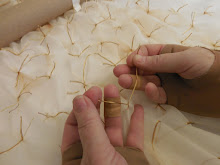
If any exercise were constructed to promote randomness, surely this is it. But no. In discussion afterward, several people talked about their impulse toward order despite sightlessness and said they used the edge of the fabric as a guide or that they felt for spaces without stitching to fill with stitching. I was disappointed in my result. I’ve been embroidering for so long that the stitching came out fairly straight, flat (no puckering), and even, just from habit:
white kantha stitching, red-orange basting

I’m having better success at home, sewing sighted but not looking at the fabric, and checking from time to time to ensure something like randomness:
blind-stitched scroll (in progress),
prompted by a collaboration between
Terry Jarrard-Dimond and Kathy Loomis

 In class, after the exercise, Dorothy showed us a sample from another class for which the students had added deliberate red kantha stitching to their blind white kantha stitching and assembled the pieces into a large sampler:
 
And it seemed to me that this exercise has at least as much to say about living as it does about sewing. Gather your supplies. Prepare your materials. Keep it somewhat simple. Meet with your tribe. Do the work. When you lose your thread, ask for help. Accept help. Begin again. Review what you’ve done. Learn from one another. Celebrate each person’s effort, contribution, and accomplishment. Carry the learning into the larger world. It’s not too bad a philosophy to spring from a random four inches of cloth, and one very remarkable, not at all random, teacher.
Dorothy creating a freize of our fingerpainted panels.

Monday, June 6, 2011

and then we set it on fire

I know what you're thinking -- isn't Dorothy Caldwell renowned for her embroidery? Yes. Deservedly so. I'll get to that.

The supply list asked for some odd things -- a hammer and a large nail, a candle and matches, incense -- but did not ask for a sewing machine. I was very distracted by this omission.  Was bringing the machine assumed? What if I'm the only person without one? But the class is, after all, called Human Marks, and nothing electrified was needed.

With the candle -- preferably, as it turns out, a cheap candle that smokes -- we made traceries on paper. On the beautiful Arches paper that was in the class kit, the smoke came up very delicately. You can see it under and between the sewn-on doo-dads on this page.

Smoked Arches paper

One of the women in the class first did a watercolor wash, then smoked over the wash, and then scratched into it. I thought this was extraordinarily beautiful and tried it at home on bought-at-Michael's Strathmore watercolor paper. (Sorry this is a bit out of focus, I'm having some trouble with my eyes which is giving me trouble with my camera.)

Left: smoke alone. Middle: watercolor wash.
Right: smoke over wash and scratched.
The smoke-over-wash is darker in real life, but this gives the general idea:
 I think the Surrealists called this "fuming."

an exit from one place

may be an entrance to another.

I've been sad this weekend. I’ve realized that a friendship that once meant a great deal has ended and that we’ve grown apart in ways that probably preclude coming together again. No one’s fault, just one of those things that happens. The realization has made me sad, and also oddly relieved. It’s been frustrating to struggle and try to keep a machine going when the parts no longer fit. Accepting that something is broken in a way that can't be fixed admits the opportunity of moving on to a less frustrating circumstance.

But first, feel sad.